Friday, June 15, 2018

Carrie's Market Picks June 2018

Two of my top picks for the farmer's market this week come as a result of helping my cousin Ali and her husband Jonah at Teter Organic Farm last summer. Jonah introduced our family to kohlrabi and a variety of turnips called Hakurei turnips. As avid vegetable lovers, we couldn't believe what we had been missing out on in the vegetable world!

When we planned our garden and decided what we would sell at our market for 2018, we made sure to include plenty of kohlrabi and Hakurei turnips!

Our June market booth

If you are out and about, and looking for something fun to try this week from your farmer's market, I suggest picking up these three things...

1) Kohlrabi- this vegetable kind of looks like an alien head, but it has a delicious cabbage-like flavor and an incredible crunch. Our favorite way to eat it is to cut it into sticks and dip it in ranch, which is super refreshing on a hot day! We also love to toss slices of it with olive oil, salt, and pepper, and grill it for dinner.


2)Hakurei Turnips- these are amazing turnips. They are sweeter and less starchy than the turnips we've all grown up with, and are a great on salads or roasted in the oven. They also make a beautiful addition to a crudité platter.


3) Romaine Lettuce Heads- If you can find full heads of lettuce, they are beautiful and vibrant. The leaves are great for salads, wraps, and grilled with a drizzle of green goddess dressing (or whatever your favorite dressing may be)!


Hope you get to try some of these fun vegetables this season!

Thursday, May 24, 2018

Picking and Storing Asparagus


It’s the time of year where asparagus is popping up through the dirt in Indiana. It seems to grow before our eyes, starting itty bitty in the morning and pushing half a foot by evening.
Whether you have your own asparagus patch or you are purchasing it at the grocery or farmer’s market, you should look for 8-10 inch spears with nice tight heads.

Tight head

Starting to bloom

If you grow your own asparagus and the heads are starting to bloom, it’s still okay to eat it! But if you are buying it, the tight heads show that it is fresh, so get your money’s worth and purchase the fresh ones.
When you pick asparagus you want to cut it with a sharp knife at the base of the spear. Cut anything with a diameter thicker than a pencil. If it’s the same diameter as a pencil or smaller, it’s best to let it grow to give energy to the plant for next year.


You should store asparagus like you would a bouquet of flowers, freshly cut in a Mason jar or glass of water. Asparagus will last on the counter in water for a day or two, and in the fridge for a week.

Enjoy!

Friday, April 27, 2018

Seasonal Eats- April

As an avid Indiana gardener, I’m always a little entertained when I read recipe ideas or watch cooking shows featuring seasonal recipes in April. They include things like parmesan roasted asparagus, buttered peas, radishes and salad greens, and fresh strawberries! Yum!
Buying local food and from farmers markets is super trendy right now, so a lot of the articles I’ve read say things like, “Just go down to your local farmer’s market and look for the freshest asparagus, or, “Buy strawberries now, because they are in season!”
But here’s the thing. These things may be locally available in other parts of the country, but they are definitely not growing here in Indiana yet. If you are shopping for asparagus, or peas, or strawberries at the grocery store, they have been shipped across the country, not grown in Indiana!
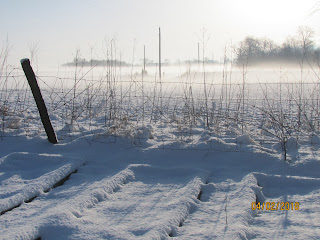
April garden beds in Indiana
When I was working at the farmer’s market last year, I saw a lot of this. There were all kinds of veggies and fruits people thought that us growers should have because they could find it “seasonally available” at the grocery, and were disappointed to find they weren’t available yet at our market.
In fact, most Indiana farm markets won’t even open until May because there just really isn’t much to sell yet. (The exception to this would be local growers who can afford a heated greenhouse to get a head start on vegetables.)
So what is actually growing right now? If you truly wanted to eat in season and locally, what would you find?
In our garden you would find…

Run-up Turnip Greens. We planted these late last summer and they overwinter and pop up again in early spring. The small leaves are tender with a slight spiciness to them. My hubby and I will use them for a salad (nothing like eating fresh greens when you have eaten home canned and frozen vegetables all winter…sooooo good!) and my kids will tolerate the slight bitter leaves in soups and stews.
Curly Leaf Kale
Red Russian Kale
Kale- another hearty green that overwinters in the garden well! We planted this kale last fall and it started to thrive again in early April. The frosts make this normally bitter green sweeter, so it’s definitely a special treat if you can find it or grow it in the spring. Later varieties you find throughout the summer won’t be nearly as tasty and a lot more bitter once it starts to heat up outside.


Spring garlic- We don’t usually pick or eat our garlic in the spring unless we are desperate for fresh garlic because the bulbs are still small. But spring garlic can be found at markets. It is milder in flavor than summer garlic. You can also find garlic scapes (also known as garlic chives) which are the tender shoots that garlic plants put up in the spring. These look like chives, but have a garlic flavor and are absolutely delicious to cook with.

Spring Onions- we grow these Egyptian Walking Onions, which are amazing! They overwinter and you can see that they are already vibrant and ready to eat! The whole plant of this variety can be eaten, the roots like a normal onion and the tops as green onions.


Herbs- we have tarragon, oregano, mint, lemon balm, sage, and cilantro springing up in our garden. While herbs don't constitute as a meal by any means, they do add great flavor to your food!

And don’t worry, if you are dying to try parmesan roasted asparagus or buttered peas, they are on their way! They are starting to push up through the ground and should be making an appearance in May!


Saturday, April 7, 2018

Broken Things and Spring

We are calling 2018 the year of broken things. It started with the dryer, then the furnace, the T.V., the car, the stove. And then the toughie... the trampoline we penny pinched for the kids for Christmas. One gust of wind sent in up into the air and crashing through our garden fence, and in a matter of moments two things were left mangled and broken.

As we untangled the trampoline from our fence and dragged the remains across our lawn, the kids kept asking us, "Can it be saved?" "Mommy? Daddy? Is it broken? Can you fix it? Can you save it?"


 It made me think about how many times I’ve asked that in my own life, calling out to God, “Can you fix it? Is it broken? Can this mangled mess be saved?” And as spring comes, the season of renewal and fresh beginnings, I feel like it answers that question deep in our hearts. During the winter, everything in the garden looks so dead, so gray and lifeless. It's hard to imagine in the winter the life that flourishes from that patch of dirt in the summer. But as spring awakens, I see that dull patch of dirt come to life. Green leaves through dark soil, white and pink buds from brown stems, and sunshine warming the cold ground after long stretches of overcast days.


 If life feels lifeless, or hopeless, or like a mangled mess and you are wondering if it can be saved, God answers every spring with a resounding yes! The patch that looks gray and lifeless can flourish once again. In The Lion, The Witch, and The Wardrobe, Aslan stands before the creatures of Narnia that the White Witch turned into statues. They are cold, gray, lifeless, and Aslan opens his mouth, breathing life, and warmth, and color back into them again. God can stand before our lives too, and the God who breathed into the dust, creating man, can breathe into our lives and awaken and renew them once again. Happy spring!

Wednesday, November 15, 2017

The Fall Garden


I love fall gardening. Summer gardening is the type of gardening that bursts at the seams, and there is a constant flurry of activity to keep up with all of the picking, weeding, and preserving that comes with it. It is demanding and hot, the weeds come up faster than you can pick them, and there is no shortage of bugs ready to chow down on all of your hard work. And while I love our summer garden bursting with gorgeous produce, I also love when the days cool down, the hard labor is done, and gardening takes on a slower, more relaxed pace.

There’s also something pretty darn satisfying about plucking carrots out of the ground on Thanksgiving day and picking hardy winter greens, like kale, when the ground is covered in a blanket of snow! 

Carrots can be a pain to start in July so they're ready in the fall, but it's worth it! They can stay in the ground even when it's cold outside and can be harvested throughout the winter as needed, which comes in handy if you don't have a root cellar!


These turnip greens are known as run-up turnips in the south and they are the bomb! The greens can be harvested throughout the fall and winter, but the amazing thing is that you can overwinter them and they will produce one last picking of sweet, tender greens in early spring.


Nothing is worse than when a hard frost destroys our greens, and I go to the store to purchase them and am stopped dead in my tracks every time I see their outrageous price tag. Luckily not only is kale a superfood in the health world, but it's a superstar in the garden too... When everything else is dead and frozen, this stuff can take the hard frosts and snow, and due to the cold temps converting its starches to sugar, the bitter flavor mellows out too!


There are a few different cold hardy lettuces, like this red oak leaf lettuce. It holds up pretty well when the night temps dip down but the days warm up. You want to pick it mid-day when the frost has melted off of it, otherwise it makes for a soggy salad. Once our daily temp stays hunkered around freezing, it won't be good any more, so we're eating it up now!


Beets are a beautiful root vegetable for the fall garden that add an earthy flavor to fall dishes.


One of my favorite things to grow are beans. I could get on a soapbox proclaiming all the virtues of dry beans, but I'll save that for another post! I start dry beans in July and harvest them in the fall. Dry beans are the staple of several winter dishes at our dinner table, they store well, and anything we don't eat (or decide to save) can be planted the next summer.


We tuck in our fall plants at night under coverings to protect them from hard frosts.


Sometimes we forget and they get covered in ice.


Whoops!


A gentle spray of water helps to melt the ice.


This kale looks as good as new!

Happy gardening!


Wednesday, August 9, 2017

Farmer's Market Hobo Packs

When I was a kid, one of my favorite weeks every summer was when my mom loaded all six of us girls into our red suburban, Ida Red, and made the long trek to Lincoln State Park in Indiana to camp with my grandparents and cousins.

My sisters, my cousins, and I loved to run the trail around the lake and climb the fire tower. We counted every step and stared out over the trees to see if we could spot a real forest fire. Good thing we never did!

We always visited Lincoln’s boyhood home, swam in the lake, were forced to watch the play about Abe Lincoln because it was educational, and looked forward to seeing musicals, like Oklahoma and The Music Man in the amphitheater. And then, after a long day of fun-filled activities, came the evenings spent around the campfire, telling stories and cooking the most delicious food. We ate the normal camp fare of hot dogs and s’mores, but it was tradition to make hobo packs with my grandparents, something they did with their own kids and with the boy scout and campfire girl troops they used to lead.

During the summer, my mom would often make these on the grill for a quick and easy meal with vegetables from our large garden. She’d hand each of us our own square of tinfoil… and believe me, when you are the oldest of six girls, your own square of anything is practically a miracle. Nothing was off limits to my little sisters; my bed, my favorite clothes, my books, my diary… even my toothbrush! So to have my own foil packet, where I could pick my own vegetables, was a pretty big deal. My mom always gave us a permanent marker to write our names across the top of the packets before we stuck them on the grill or campfire (a lesson learned one day after a huge fight about whose foil packet was whose).

A hobo pack is a Boy Scout camping staple, created with large squares of tinfoil shaped into a packet. It’s normally stuffed with some sort of meat and veggies, sealed, and placed over a campfire to cook. It's an excellent way to use up veggies and the clean-up is ridiculously easy. You just roll up the tinfoil and toss it (or if you live in a family with six kids or a frugal grandmother, you clean it and save it for next time).
I make all kinds of versions of these throughout the summer, but this one is similar to the one from my childhood. These proportions will make four hobo packs.

Ingredients:
1 lb. smoked sausage chopped into thick chunks

2 ears of corn cut into 2 inch rounds

1 lb. baby potatoes (or four medium sized potatoes sliced thinly)

1 small onion, sliced thinly

1 small pepper, sliced thinly

1 small zucchini, sliced thinly

4 cloves of garlic, smashed

2 teaspoons salt

2 teaspoons of pepper

4 tablespoons of butter

Splash of white wine


You can see from the picture above that we also threw in some beans, tomatoes, and mushrooms. The best thing about these packets is that it's a great way to use up all those extra veggies from the garden or market!


Fold your four squares of tinfoil into pockets or squares and spray with cooking spray.  Divide and layer the meat and veggies between the four packets . If you are using potatoes, you can microwave them for five minutes or parboil them to make sure they are cooked through when you eat them.


Sprinkle the meat and veggies with salt, pepper, and any other of your favorite seasonings. I added fresh tarragon to these ones. Finish it with a drizzle of olive oil or a pat of butter, and for the grown-ups I love to add a splash of white wine. Seal the sides up, write your name on top to be sure you don’t have a major family fight, and put it on the grill over medium/high heat for about 20 minutes.


We eat ours straight from the steaming foil with chunks of flatbread to soak up the juices!
Chowabunga!

Friday, July 7, 2017

Giving Tomatoes Room to Breathe

When the summer heat wears off for the day, I get a lot of peace from trimming tomatoes. It has that Mr. Miyagi feel to it, like when he is trimming Bonsai trees in The Karate Kid. However, trimming tomatoes just isn't for relaxing, tomatoes tend to be a plant that bush out quickly, and it does a lot of good to prune them back.


These tomatoes pretty bushy, and if you look closely, you can see that the leaves are starting to yellow at the bottom.


I took quite a few leaves off of them!


Either they needed a lot of trimming, or I just needed a lot of peace...ha!


These are healthy and vibrant tomatoes from our 2016 garden.


If you take a close look at those tomatoes, you can see they aren't quite as healthy and vibrant as they seemed to be. The leaves are starting to get diseased because they are so thick and bushy that they don't have "room to breathe", or as most gardeners would say, they don't have enough air circulation. If they aren't taken care of, the plant can go from looking vibrant to shriveled in a matter of days.


Freshly trimmed tomatoes may look a little bare, but the extra air circulation from the pruned plants will produce a gorgeous, disease free crop of tomatoes.

When I'm trimming tomatoes, I can't help but think of my own life and how much my family and I need room to breathe. I tend to be a volunteer-for-everything type of person, and before I know it, our lives are a tangled mess of too many activities, and we can go from thriving to barely surviving pretty quickly.

You'd think trimming out activities would make life feel pretty bare, but it opens up space and growth for important things, like building memories in the backyard, catching fireflies and playing Frisbee. Trimming back for us means standing around the grill, savoring the smell of smoky chicken and telling stories, or sitting on the old swing watching the sun go down. Abundance in life doesn't necessarily come from filling every nook and cranny with activities, but from being able to savor the things that truly matter, and sometimes to truly enjoy those things, you've got to be willing to trim some things out and give yourself a chance to breathe.